

Some dates are burned into our minds.
November 30, 2022
ChatGPT launches and takes the tech world by storm. It felt like magic.
Now there’s another.
September 15, 2026
Jev launches as a new model from TypeSafe. It does not chat. It does not write code. All it does is answer yes or no as a probability.1

This sounds like a step backwards.
But is it? A lot of human judgement is taking a big problem and breaking it up into small simple questions. We do this implicitly.
Let’s say a colleague asks us for help with an email. We don’t just say, “This is bad.” We point out where it’s defensive or wordy so they know what to fix.
Jev can run those same checks and return a probability for each. Even when the question is yes or no, the judgement is rarely black or white.
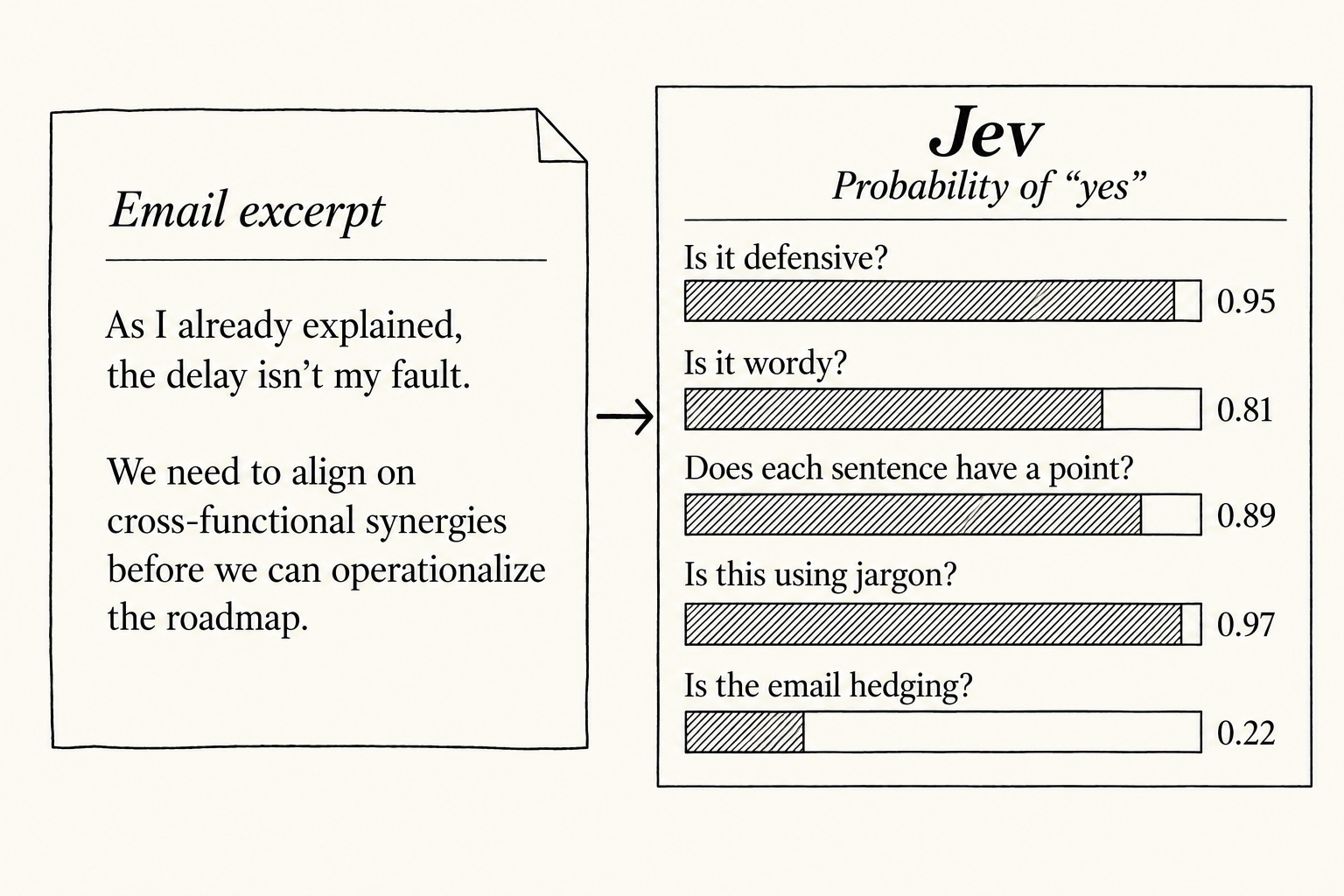
Not only is Jev good at this, it’s also roughly 200x faster than top LLMs and 400x cheaper in TypeSafe’s workflow tests. The cost and speed make it practical to run these checks on every customer interaction.
If you want to try it for yourself, check out this demo.
What else can Jev do?
Jev encodes judgement at scale. Give it a customer message, a project contract, or your style guide. Then ask:
Is this customer ready to churn?
Is the client’s request in the project scope?
Does this wire request look suspicious?
Does the invoice match what we agreed on?
Does this ad follow our style guide?
Each answer comes back with a probability that the business can use to trigger the next step, whether that means flagging a suspicious payment for review or sending an ad back for revision.
It’s ironic that a model that can’t write an email or code is ushering in the next phase of AI. Jev productionalizes judgement.
That’s why September 15 matters.
This is simplified. Jev can also choose between options and give scores, but the idea is the same: it gives a probability instead of writing an answer.